
- This event has passed.
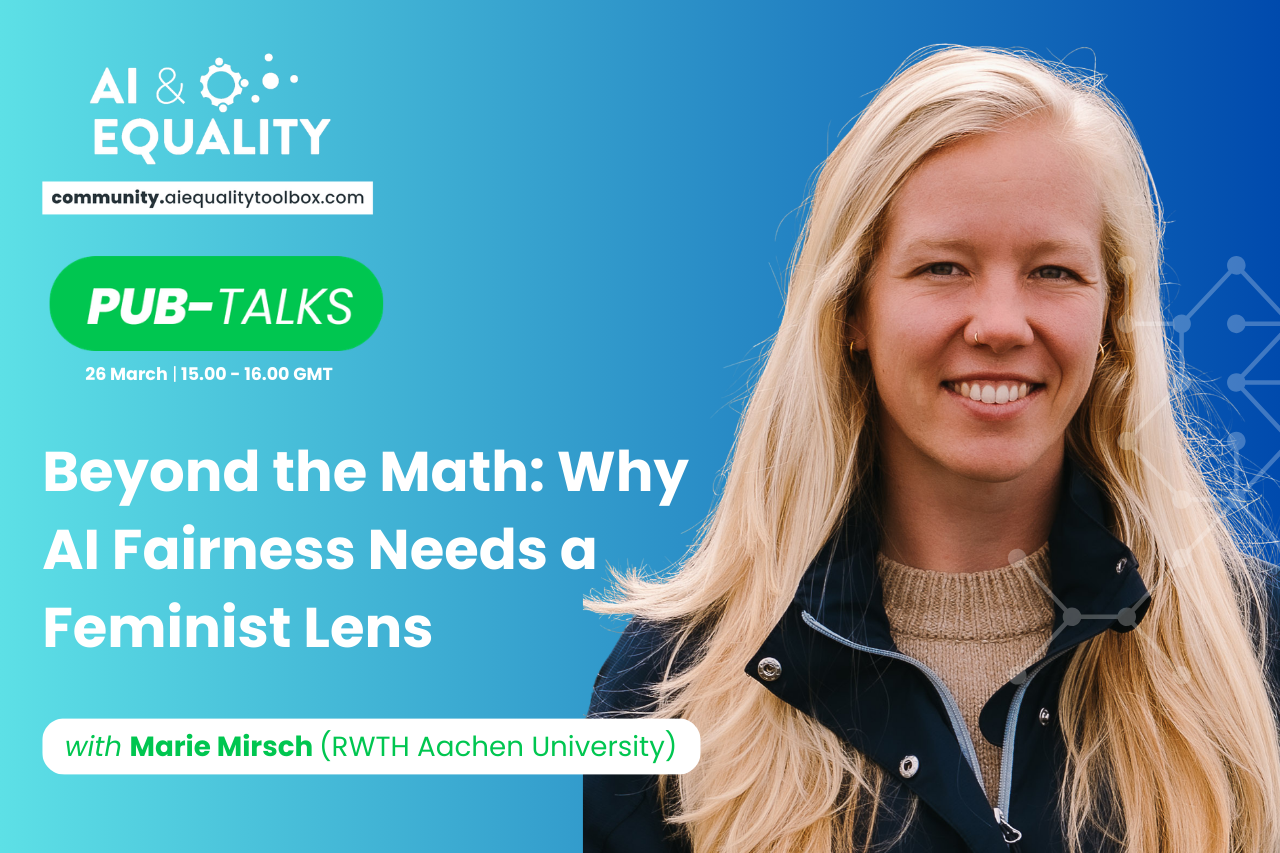
Beyond the Math: Why AI Fairness Needs a Feminist Lens with Marie Mirsch | AI & Equality Pub-Talk
March 26 @ 3:00 pm - 4:00 pm
🔗 Access paper: https://link.springer.com/article/10.1007/s43681-025-00926-y
Although research on algorithmic fairness is inherently interdisciplinary, many proposed fairness approaches remain predominantly technical in their treatment of societal concepts such as fairness and justice. While these approaches often claim to operationalize insights from the social sciences, they frequently do so in ways that appropriate rather than meaningfully engage with the underlying theories. This paper critiques this practice through the lens of intersectionality. Adopting a “calling in” rather than “calling out” stance toward AI practitioners, it offers actionable guidance on how intersectionality can be substantively incorporated into technical work, thereby recentring social science theory within the field of algorithmic fairness.
About the speaker:
Marie Mirsch, M.Sc., is a research assistant and doctoral candidate at RWTH Aachen University. She conducts research at the intersection of mathematics, ethics, and social sciences, intending to anchor diversity perspectives in technology. Her interdisciplinary research focuses on intersectionality in the context of algorithmic fairness – a central topic of current AI research. She also considers aspects of procedural fairness and participatory approaches, such as including citizens’ perspectives. As part of her work at the bridging professorship “Gender and Diversity in Engineering”, she also deals with ethical issues relating to using artificial intelligence in engineering. A Research Fellowship from the BMBF-funded AI Campus supports her research.
As project manager of the Responsible Research and Innovation (RRI) Hub at RWTH Aachen University, she coordinates and implements national and international projects to strengthen social responsibility in technology development as part of the “ENHANCE – European Universities of Technology Alliance”.
Her teaching activities include the seminar “Responsible AI for Engineers” at RWTH, the online course “Responsible Innovators for Tomorrow” as part of the ENHANCE alliance, and the workshop “Responsible AI” at the University of Koblenz.