One organisation, several connected initiatives, and a web of institutional partners, all working to build technology that strengthens democracy, advances equality and protects human rights.
The work spans several initiatives that share one foundation: a human rights-based approach to AI.
They are distinct projects, but they are not separate efforts. Each grows from the same method and feeds back into it.
Women At The Table (w@tt) is the organisation behind the work, operating at the intersection of human rights, gender equality, democracy and AI governance.
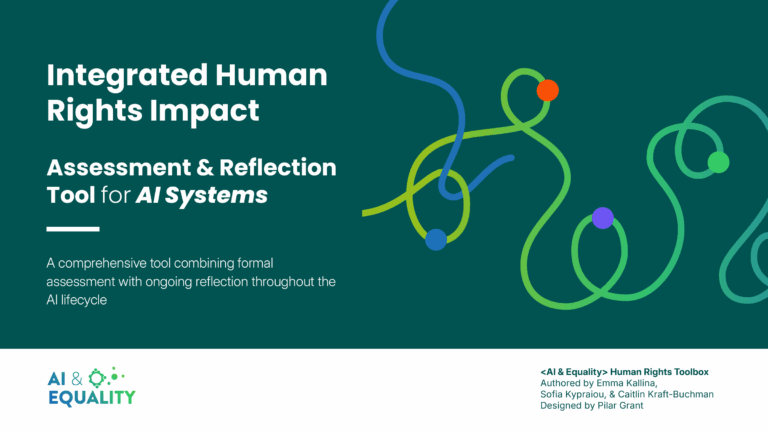
AI & Equality is its human rights and technology initiative: the Toolbox, the community, and the course, where the method is built, taught and put to work.
HumRights-Bench is the research edge: the first expert-validated benchmark for whether AI models can reason about human rights at all.
The African and Latin American Toolboxes adapt the method with regional partners, led from those regions rather than handed to them.
The community connects researchers, technologists, lawyers and organisers across 59 countries, and its work lives in the Library.
The A+ Alliance for Inclusive Algorithms is a global, feminist coalition working to reduce bias in algorithmic systems, co-led with Code for Africa. Where the toolbox asks how AI gets built responsibly, A+ asks who gets to build it. A+ founded the global Feminist AI Research Network, and now funds and mentors women’s rights organisations in Sub-Saharan Africa to develop their own AI solutions through the Gender and AI Innovation Coalition. It convenes researchers and practitioners around a simple proposition: a free, feminist and inclusive digital future, designed by the communities AI most affects.
The method is built and tested with institutions, not in isolation. The global Toolbox was developed in collaboration with the UN Office of the High Commissioner for Human Rights and EPFL.
The course carries a certificate from the Sorbonne Centre for AI. The African Toolbox is built with the African Centre for Technology Studies (ACTS); the Latin American Toolbox with CENIA and the University of Chile.
The work engages directly with the bodies shaping AI governance, including UN processes and the Council of Europe’s framework on AI and human rights.
Distinct projects, one method, one entity. To see where it started, read our story. To put the tools to work, start with the Toolbox.