




Digital Futures Lab
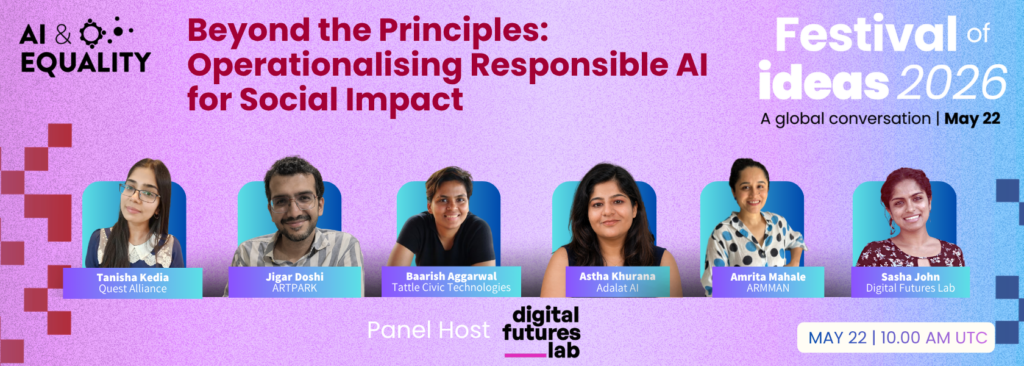
This panel draws on experience from India's social impact ecosystem — one of the most active and complex testing grounds for AI in development contexts globally, where scale, diversity, and institutional constraint make the challenges of responsible deployment particularly salient. The questions it surfaces, however, are not unique to India: organisations across the Global South, and anywhere AI is being applied to critical service delivery in under-resourced settings, are navigating the same tensions between ambition and accountability.

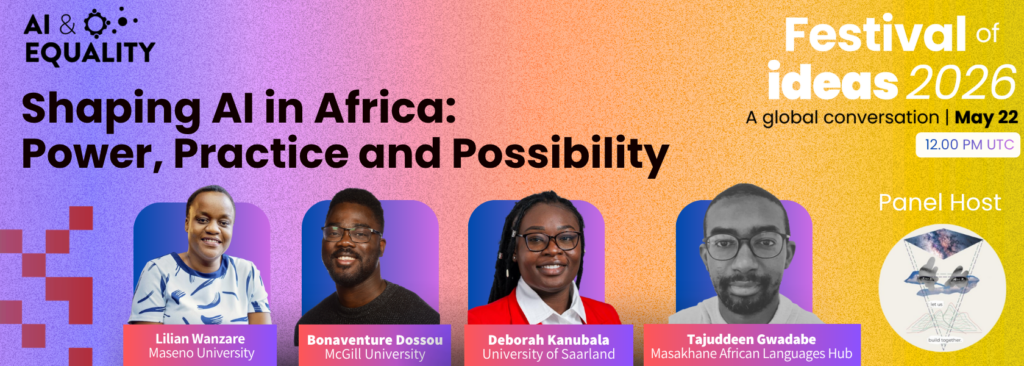
Shaping AI in Africa: Power, Practice and Possibility
12.00 - 13.30 UTC
Bringing together voices from across the Masakhane ecosystem, the conversation will span six interconnected themes: how data is being collected on the ground and the ethical questions that come with it; the role of communities as active participants and builders; the current state of AI adoption across the continent, from thriving urban tech hubs to underserved rural areas; the policy frameworks emerging at national and continental levels; the long-neglected landscape of low-resource African languages and the models being built to serve them; and finally, a collective forward-looking discussion on what the future of AI should look like for Africa.

Who Governs the Data? Community-Led AI from the Global South
This panel draws on real, on-the-ground work with communities in Malawi, the Philippines, and Kenya to examine what genuine community authority over AI actually looks like in practice. The panel explores what has worked, what hasn't, and what it takes to shift power toward communities in ways that are lasting and structurally embedded rather than performative.
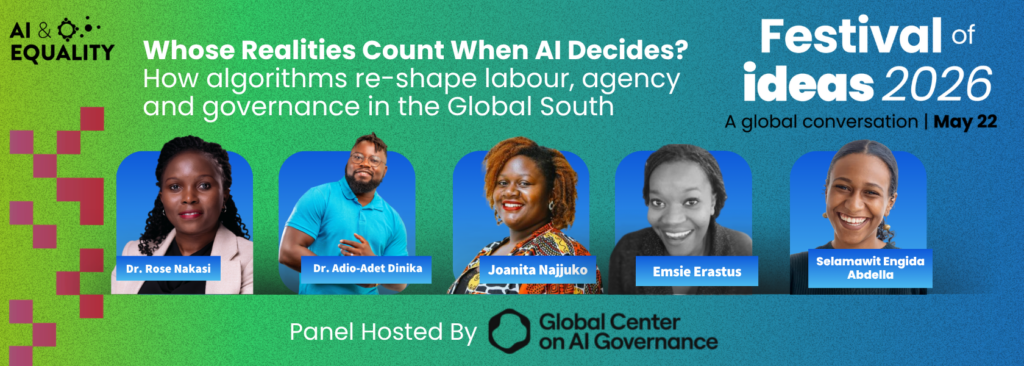
Whose Realities Count When AI Decides? How algorithms re-shape labour, agency and governance in the Global South
This panel brings together perspectives from innovation, governance, health, labour and gender justice to examine how algorithmic systems reshape agency and institutional decision making in practice. Moving beyond abstract debates about ethics, the discussion explores how priorities are set within AI systems, what forms of public interest technology are emerging across sectors and what it takes to ensure that communities closest to the consequences of these systems are also closest to shaping them.

The hidden building blocks of AI: labour, land and bodies
This panel will explore the often invisible infrastructures that sustain AI systems, focusing on how these processes are deeply shaped by gender dynamics. The session will look specifically at gendered and precarious digital labour (such as data work and content moderation), extractive dynamics tied to land and resources, and the impacts of these systems on bodies and everyday life.

Towards a Citizens’ Track on AI: Putting People in the Lead
Bringing together examples of participatory engagement around AI, and of citizen deliberation in other fields, this session will look at how we can build on emerging practice to call for a Citizens Track in AI Governance - creating space in the evolving landscape of AI Governance for direct public engagement.

Anna-Maria Gueorguieva
PhD student at the University of Washington Information School, her research focuses on creating and conducting evaluations for the behavior and usage of AI systems in social and political contexts as well as contributing to AI and data governance through research evaluating the effectiveness AI and data privacy laws in the United States.

Leyla Roksan Caglar
Postdoctoral Fellow in the Windreich Department for AI & Human Health at the Icahn School of Medicine at Mount Sinai, working at the intersection of neuroscience, AI, and cognitive science to understand how systems with different learning mechanisms acquire, generalize, and represent perceptual information and how we can use these insights to build safe, transparent, and responsible AI systems.

Marie Mirsch
Doctoral candidate at RWTH Aachen University. Marie conducts research at the intersection of mathematics, ethics, and social sciences. She is also the Project manager of the Responsible Research and Innovation (RRI) Hub at RWTH Aachen University, coordinating and implementing national and international projects to strengthen social responsibility in technology development as part of the “ENHANCE - European Universities of Technology Alliance”.

Marit Brademann
Extern with the AI Policy Lab at Umeå University and graduate student in epistemology at the University of Edinburgh, Marit researches the governance of the cognitive demands of AI tools and their impact on the right to education. She is also a Junior Fellow of the AULA Fellowship, where she helps ignite conversations on critical AI literacy.

Steph Wright
Steph has a diverse background ranging from astrophysics to genomics in academia, film & TV, and the third sector. A leader and advocate for ethical, inclusive and responsible AI, she was instrumental in the development and delivery of Scotland’s first national AI strategy. Co-Founder/CEO of Our AI Collective, Steph was recognised as one of the 100 Brilliant Women in AI Ethics and one of the Top 10 Women in Tech in Scotland in 2023, and was named in the 2025 Digital Leaders AI 100 UK list. She was also awarded the 2024 DataIQ Award for Data & AI For Good Champion.

Amina Soulimani
PhD Candidate in Anthropology at the University of Cape Town (South Africa) investigating human-machine interactions in hospitals, and contextualized ethics of care. Doctoral Research Fellow at HUMA — Institute for Humanities in Africa.

Caitlin Kraft-Buchman
A serial coalition builder from New York, she is permanently based in Geneva and the CEO/ Co-Founder of Women At The Table (2015) whose mission is to forge technology that strengthens democracy, advances gender equality, and enhances human rights. Women at The Table has two daughter initiatives: A+ Alliance for Inclusive Algorithms (2019) and the AI & Equality Human Rights Initiative (2021). Caitlin is also co-founder of the International Gender Champions (2015).