
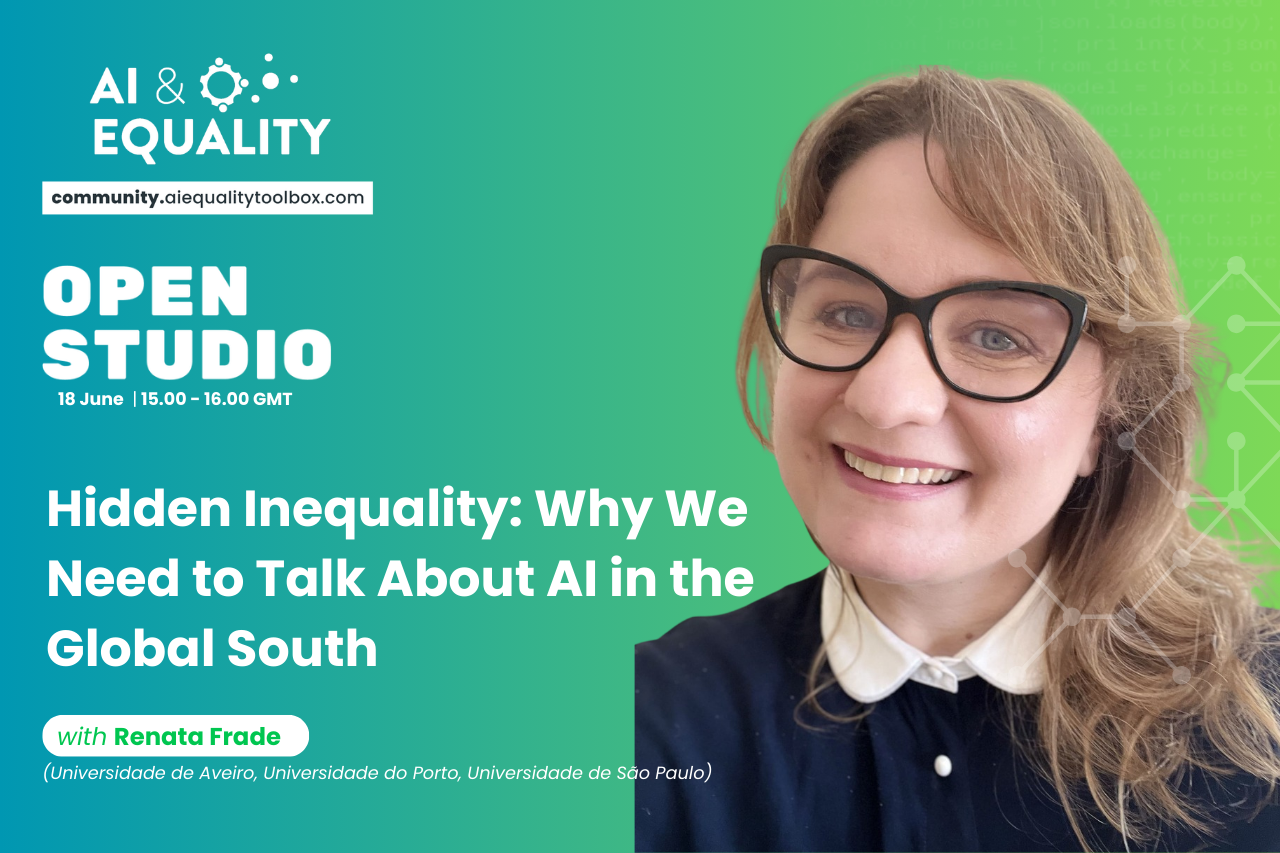
Hidden Inequality: Why We Need to Talk About AI in the Global South with Renata Frade | AI & Equality Open Studio
June 18 @ 3:00 pm - 4:00 pm
This 30-minute talk is grounded in two complementary research trajectories:
(1) extensive digital ethnography with 247 women-led technology communities, focused on platforms, communication, participation and power (not AI-specific), and (2) parallel academic studies on AI, inequality and the Global South, examining how automated systems interact with structural asymmetries, governance gaps and cultural contexts.
Rather than presenting a technical or proprietary AI framework, the talk offers critical insights and reflective lenses on how AI becomes socially invisible, how inequality is reproduced through discourse and design, and why communication is central to a human-rights-based approach to AI.
Key Themes:
- What Platform Research Reveals About Power and Visibility
- Insights from digital ethnography with 247 women-led tech communities
- Patterns of participation, exclusion and symbolic inclusion in digital platforms
- Why these dynamics matter when AI is introduced into social and institutional systems
AI and Inequality from a Global South Perspective - Findings from research on AI, gender and structural inequality in the Global South
Asymmetries in data, labor, governance and technological dependency - The risks of applying “universal” AI solutions without contextual grounding
- Communication as a Human Rights Issue in AI Systems
- How language, interfaces and narratives shape accountability
- Why transparency alone is insufficient without accessibility and participation
- The role of critical literacy in rights-based AI approaches
About the speaker:
I am an interdisciplinary feminist researcher with deep experience in advancing feminist, decolonial, and participatory ethics in technology, particularly across Latin American and Lusophone contexts. My doctoral research mapped and analyzed 247 communities of women in technology in Brazil and Portugal, applying participatory and justice-oriented methods designed to center marginalized voices—often those of adolescents and youth in vulnerable contexts. Through projects such as Fiocruz Hack Girls and the LitGirlsBr platform, I have engaged directly with adolescent participants, developing empowering digital literacy and inclusion programs.