AI and Equality

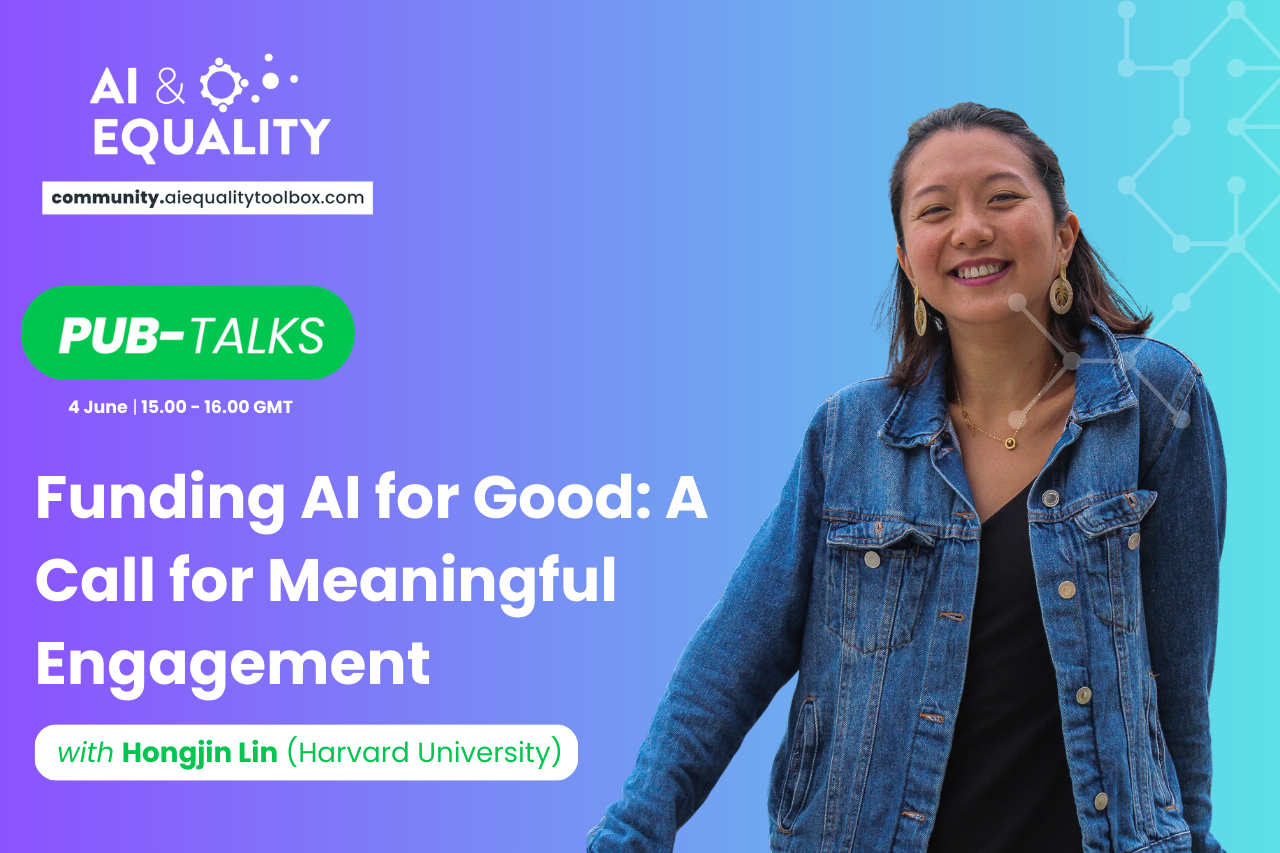
Funding AI for Good: A Call for Meaningful Engagement with Hongjin Lin | AI & Equality Pub-Talk

Artificial Intelligence for Social Good (AI4SG) is a growing area that explores AI's potential to address social issues, such as public health. Yet prior work has shown limited evidence of its tangible benefits for intended communities, and projects frequently face inadequate community engagement and sustainability challenges. While existing literature on AI4SG initiatives primarily focuses on the mechanisms of funded projects and their outcomes, much less attention has been given to the funding agenda and rhetoric that influences downstream approaches.

Hidden Inequality: Why We Need to Talk About AI in the Global South with Renata Frade | AI & Equality Open Studio

This 30-minute talk is grounded in two complementary research trajectories:
(1) extensive digital ethnography with 247 women-led technology communities, focused on platforms, communication, participation and power (not AI-specific), and (2) parallel academic studies on AI, inequality and the Global South, examining how automated systems interact with structural asymmetries, governance gaps and cultural contexts.

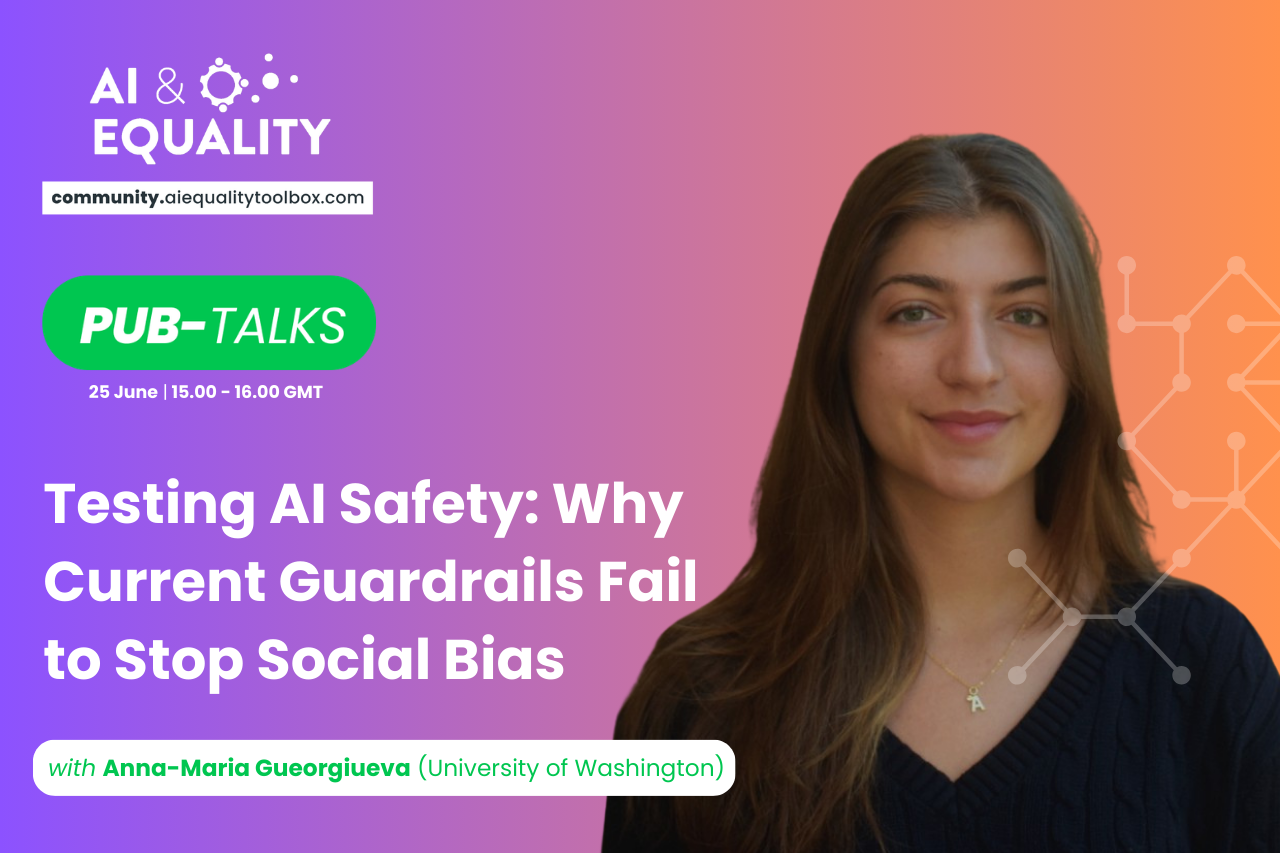
Testing AI Safety: Why Current Guardrails Fail to Stop Social Bias with Anna-Maria Gueorgiueva | AI & Equality Pub-Talk

How do large language models understand the lived experiences of stigmatized groups, and when does this understanding differ from the human perspective? Can this lead to bias, and if so, do our existing safety tools help mitigate such bias? This work investigated open-source language models for bias against 93 stigmatized groups, identifying that specific types of biases (especially those deemed by humans to be 'threatening' such as having HIV or a criminal record) experience significantly more bias than other types of stigmatized identities.

Moving Beyond Big Tech: Blueprints for Community-Led Language AI with Claudia Pozo | AI & Equality Pub-Talk

The digital world suffers from a profound linguistic disparity, particularly in Africa where a lack of local language content and traditional, Global North-led language technology models fail to meet community needs, often resulting in data extraction and inequitable solutions. In an 18-month research project, in collaboration with the Distributed AI Research Institute (DAIR), we highlight a powerful alternative: a growing grassroots movement of community-based language technology initiatives across Africa that adopt a bottoms-up approach, prioritizing local needs and incorporating indigenous philosophies.