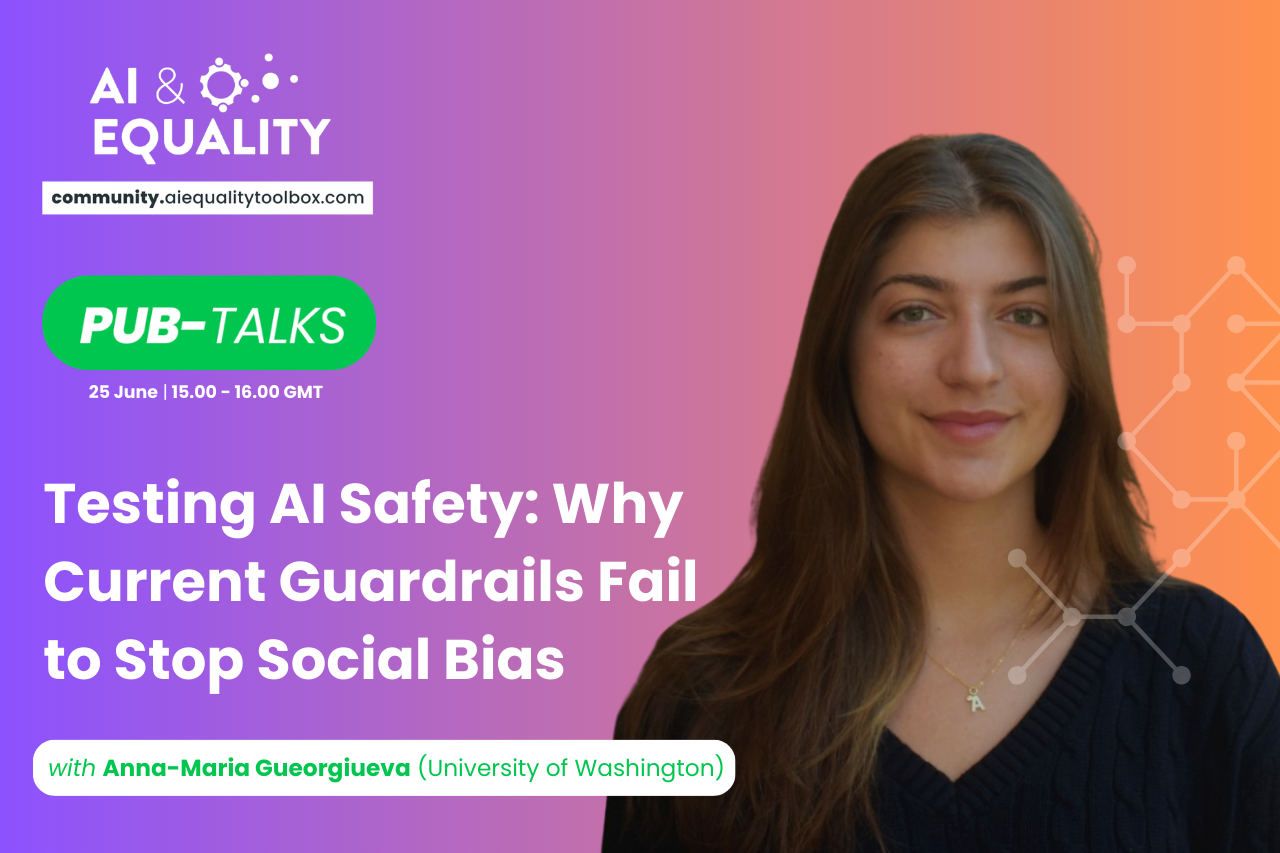
• Testing AI Safety: Why Current Guardrails Fail to Stop Social Bias with Anna-Maria Gueorgiueva | AI & Equality Pub-Talk

    AI & Equality Community | Events

    How do large language models understand the lived experiences of stigmatized groups, and when does this understanding differ from the human perspective? Can this lead to bias, and if so, do our existing safety tools help mitigate such bias? This work investigated open-source language models for bias against 93 stigmatized groups, identifying that specific types of biases (especially those deemed by humans to be 'threatening' such as having HIV or a criminal record) experience significantly more bias than other types of stigmatized identities.
  • Moving Beyond Big Tech: Blueprints for Community-Led Language AI with Claudia Pozo | AI & Equality Pub-Talk

    AI & Equality Community | Events

    The digital world suffers from a profound linguistic disparity, particularly in Africa where a lack of local language content and traditional, Global North-led language technology models fail to meet community needs, often resulting in data extraction and inequitable solutions. In an 18-month research project, in collaboration with the Distributed AI Research Institute (DAIR), we highlight a powerful alternative: a growing grassroots movement of community-based language technology initiatives across Africa that adopt a bottoms-up approach, prioritizing local needs and incorporating indigenous philosophies.

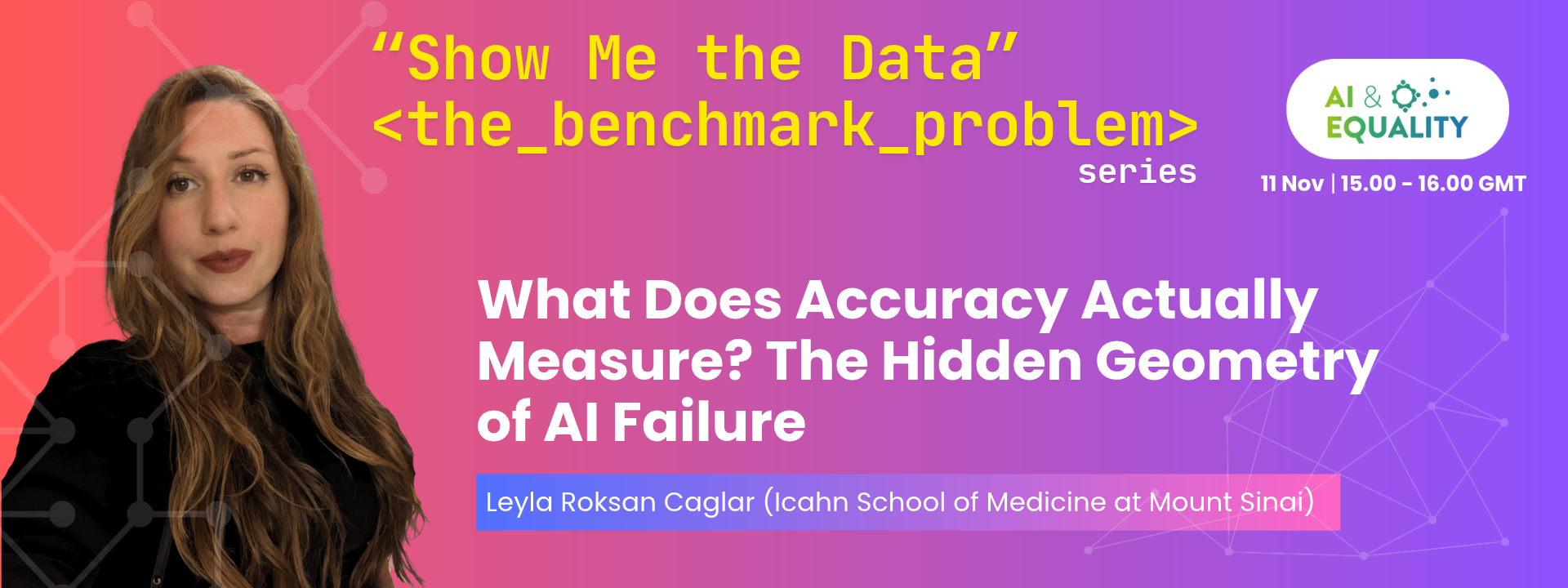
  • What Does Accuracy Actually Measure? The Hidden Geometry of AI Failure

    “Show Me the Data” is a new AI & Equality series on the hidden assumptions built into AI benchmarks. Each session takes one influential benchmark or evaluation framework - in vision, language, healthcare, criminal justice - to ask who designed it, what population was it validated on, what does it reward, and who does it fail?

  • Reading Circle: Narrative frames and re-framing narratives

    For November; we will be reading this book chapter on Narrative frames and re-framing narratives: from AI as labor futures and regulation to AI as precarities and problematics by anthropologist Sareeta Amrute, a chapter in the Handbook on Anthropology and Artificial Intelligence edited by Sahana Udupa and Peter Hervik (Edward Elgar, 2026).

  • Reading Circle: AI ethics through a decolonial lens

    In December, we'll be discussing AI ethics through a decolonial lens: what does AI ethics look like if we take seriously the push to decolonise it? by Selena Nemorin and Beatrice Bonami, published open access in AI & Society in Feb 2026.